When I saw the Paper Players challenge theme Nature’s Landscapes, I was reminded that I still had a DIY landscape panel left over from a project I made back in June. I originally paired it with a hot air balloon. I had a little section of the panel remaining, though, and thought it would be fun to see what else I could do with it.
I pulled out my Hey Birthday Chick stamp set and found this particularly cute chicken with a balloon tied to her little tail. There was something about the idea of her floating above that colourful landscape that made me smile, so I decided to give it a try.
And this is what I came up with.
Want to see where the landscape started?
You can see the original card I made with this landscape panel HERE.
I also made a YouTube video showing how I created the larger landscape background from scraps, which is the panel I've used on both cards.
I always love seeing how a piece of leftover paper can take on a completely different life the second time around. One landscape, two very different cards 😊
The original Landscape from Leftovers project is also featured in Cardmaking with Scraps Issue 2, my next collection of scrap-friendly card ideas.
Issue 2 will be available as a free printable for a limited time when it’s released. If you'd like a copy while it’s free, you can join my mailing list here and I’ll let you know when it’s available.
More ideas for using the scraps you already have, without needing to buy a whole lot of new things.
Have you ever had a piece of patterned paper that you absolutely love, but when you try to use it on a card, it suddenly feels like too much?
That was the question I was playing with when I made these Christmas cards.
I was working with scraps of a retired Stampin' Up! paper called All Is Bright, which features gorgeous photographic close-ups of Christmas decorations. The paper is beautiful, but it's also quite bold, so I wanted to see if I could use it on a card without letting the pattern completely take over.
And while these particular scraps happened to be Christmas paper, the ideas I'm sharing here can be used with any bold patterned paper, whether you're working with scraps or a full sheet.
Starting with scraps
The original project the scraps came from
I'd originally cut the 12-by-12-inch sheets of All Is Bright into 4-by-6-inch panels to use on card fronts. That left me with these four-inch-wide strips from the bottom of the paper.
When I saw the Global Design Project sketch #GDP562, I thought those leftover strips might be a really good fit.
I started by laying the Christmas strips horizontally across a piece of cardstock, but there wasn't quite enough of the Christmas paper to fill the space.
Rather than trying to find more of the same paper, I looked through my scraps and found a red tone-on-tone paisley pattern that was a similar colour.
It worked surprisingly well.
When I tried placing the patterned sections directly against each other, I felt like there was just too much pattern happening. So instead of completely blocking the sections together, I left little strips of white cardstock between them.
Let the patterned paper be the star
Once I'd created the background, I knew I didn't want to add lots of stamped images and embellishments. The patterned paper was already doing a lot of the visual work.
Instead, I wanted the rest of the card to support the paper rather than compete with it. This is where I think your sentiment can do a lot of the work.
Rather than choosing a small sentiment and then adding more decorative elements around it, I chose a larger Christmas sentiment from the Holly Jolly Christmas stamp set.
The combination of the different fonts gives the sentiment some visual interest of its own, which means it can act almost like another design element on the card.
Adding a little gold
I also wanted to bring in some gold, but I didn't want to add another large element to an already-busy card. So I used an old technique to selectively add gold embossing to parts of the stamped sentiment.
If you'd like to see exactly how I created the two-toned black and gold sentiment, I've shown the whole process in the video above.
Love creating with scraps?
I've collected eight of my favourite scrap-friendly projects into Cardmaking with Scraps – Issue 1, designed to help you make the most of those little pieces already sitting in your stash.
Last week, I experimented with quilt-inspired ways to use some of my patterned-paper scraps. What began as one idea ended up leaving me with several pieces to play with.
In Part I, I shared quilt-themed features made with little squares of patterned paper. Today, I'm sharing quilted panels made simply by overlapping patterned strips.
A couple of sketch challenges provided the perfect excuse to create cards with those pieces, and before long I had three cards from the same little family of scraps.
Card One
This quilted panel was made by overlapping strips of patterned paper.
The original panel was wider than you see here, but I found that the quilt effect became a little lost across the larger area, so I trimmed it down to create a narrower feature.
When I saw this week's Atlantic Sketch Challenge, with its patterned background strip and floral centre, I knew this panel would be a perfect fit.
I pulled out the roses from Stampin' Up!'s Petal Palette stamp set and liked the way the thicker line art worked with the busy patterned background. Rather than colouring them with ink, I stamped the roses onto scraps of the Tranquil Tide and Blushing Bride cardstock tones I'd already used in the quilted panel, then fussy cut them and glued them into place.
I added a piece of vellum behind the roses to soften the pattern underneath without completely hiding it. It gives the flowers a little more room to stand out while still letting the quilted background show through.
Card Two
As I mentioned, the original quilted panel was too wide for the effect I wanted, so I trimmed it down. That left me with two strips of mixed patterned paper, made up of those same diagonally cut pieces.
When I saw the Freshly Made Sketches challenge, with its three circles as the central feature, I immediately thought of those leftover strips.
The rose stamp was still sitting on my desk from the first card, and its little spray of three roses was almost perfect for this sketch's three circle feature. I used the same scrap-paper colouring technique again, this time choosing yellow cardstock for the flowers instead of pink.
This card turned into a bit of an unexpected scrap experiment of its own. I was trying different cardstock offcuts to decide what colour to use for the background when I noticed how much I liked the effect of using two different colours above and below the central strips.
It made me wonder how much fun it could be to deliberately build a background from mismatched pieces of cardstock. Another scrap idea for the list!
Card Three
I still wasn't quite finished with the original quilted-strip idea.
Although I liked the narrower panel I'd used for the first card, I wanted to see if I could make a wider version that still had that lovely quilted effect. So I went back to the patterned strips and experimented with varying their placement.
This version needed a little more manual trimming to make the pieces fit together, but I was really happy with the result. The different strips created a gorgeous diamond pattern through the centre of the panel.
Just as I did in Part I of this experiment, I decided to step it up with a little texture and ran the finished panel through the Tasteful Textile embossing folder.
For this card, I also embraced the cosy quilt feeling with a cup of tea and a Take Care of Yourself sentiment.
Watch the Video
I love that this little experiment kept giving me things to play with. And that's one of my favourite things about working with scraps. You don't always have to know what something is going to become. Sometimes you can just make the pieces, put the leftovers aside, and wait for the right idea to come along.
Love creating with scraps?
Discover Cardmaking with Scraps – Issue 1, featuring 8 scrap-friendly card projects designed to help you make the most of the pieces already in your stash.
I recently saw a card shared by Stampin’ Up! that caught my eye. It featured little squares of subtly patterned paper arranged together to create an almost quilt-like effect. Well, you know I’m always interested in an idea that gives me another way to use my scraps!
I went through my stash and pulled out a selection of papers, settling on patterns in Tranquil Tide, Lost Lagoon, Delightful Dijon, Pool Party and Blushing Bride. I used my Big Shot to cut the little stitched squares and had enough to create two 3 x 4 grids, perfect for two card fronts.
From there, I decided to make one simple version and one stepped-up version.
The Simple Version
For my first card, I kept things really straightforward and adhered the squares directly onto a folded white card base.
I chose the Sending You a Handmade Hug sentiment from the Crafting With You stamp set as it felt like a great fit for a quilt-themed project. I added a small twine bow and tucked a piece of creamy lace ribbon underneath for added texture.
Those little details might seem quite simple, but I think they make a difference. The lace, twine and handmade-hug sentiment all felt perfectly at home with the idea of a cosy, handmade quilt.
Step It Up: Taking the Quilt Idea a Little Further
For my second card, I wondered what would happen if I leaned even further into the fabric-inspired look.
Rather than adhering the squares directly to my card base, I attached them to a piece of ordinary printer paper first and, once assembled, ran the panel through my Big Shot using the Tasteful Textile embossing folder.
And I really liked what happened.
The texture seemed to bring all those different patterns together, giving the panel a lovely faux-fabric quality, almost as though I had turned my little paper squares into a piece of quilted material.
I love that I ended up with two cards using essentially the same little collection of scraps, but with quite different feels.
The first is simple and sweet, with the lace, twine and little tag adding to that handmade quilt feeling.
The second takes the same idea and pushes it a little further. The embossed texture makes the patterned-paper panel feel almost fabric-like, while the large HUG gives the card a stronger focal point.
And perhaps my favourite part is that both cards started with nothing more than a handful of little scraps. Sometimes the simplest little pieces can come together to make something really special.
If you've been following along with my previous scrap projects, you'll know I love taking one basic idea and exploring different ways to use it. In my earlier layered scrap feature cards two ways project, I created a torn version and a cleaner banner-style version.
This time, I wanted to keep the basic idea the same — layered strips of patterned paper — but explore how colour choices, cardstock, layout, and embellishments can completely change the feel of the finished card.
The same scraps, two different styles
I started by gathering together a mixture of subtle patterned paper scraps in soft blues, gentle browns and neutral patterns. To create two different looks, I separated them into two colour directions.
For my clean and crisp version, I chose softer blue patterns with more white running through the designs. Paired with a Basic White background, these papers created a lighter, fresher feel.
For my soft vintage version, I chose blue patterns with warmer vanilla tones. These worked beautifully with Very Vanilla cardstock and created a softer, more layered appearance.
It was interesting to see how changing just the background colour altered the overall mood of the papers.
Creating the layered scrap panels
For the vintage-inspired card, I took a more relaxed approach with my strips.
I layered the pieces down the centre of the card without worrying about everything being perfectly aligned. Some strips were longer, some shorter, and some overlapped slightly to create a more organic, patchwork feel.
For the clean and crisp version, I wanted a more structured look. I cut my strips to the same width and created a simple rectangle down the centre of the card. The varied heights still added interest, but the consistent width gave the panel a much more ordered appearance.
It’s amazing how the same basic idea can feel completely different just by changing the arrangement and a few design choices.
A little crafting problem solving
As always happens in handmade projects, not everything went perfectly!
The textured ribbon I chose for the clean version created a little more bulk than I wanted underneath the flower. I also found myself juggling all those tiny die-cut pieces while trying to keep the blue flower together.
In the video, I share the little adjustments I made along the way, including a ribbon trick that helped the flower sit flatter, and two different methods for creating the floral die cut.
Which style would you choose?
I love how these cards started with the same idea and the same types of supplies, but ended up with completely different personalities.
One feels fresh, clean, and structured. The other feels soft, layered, and vintage.
I'd love to know — which style speaks to you more?
Are you drawn towards clean and crisp card designs, or do you prefer softer layers and warmer tones?
It includes 8 scrap-friendly card projects with measurements, photos and step-by-step “recipes” you can keep beside your desk for inspiration when you’re working through your stash.
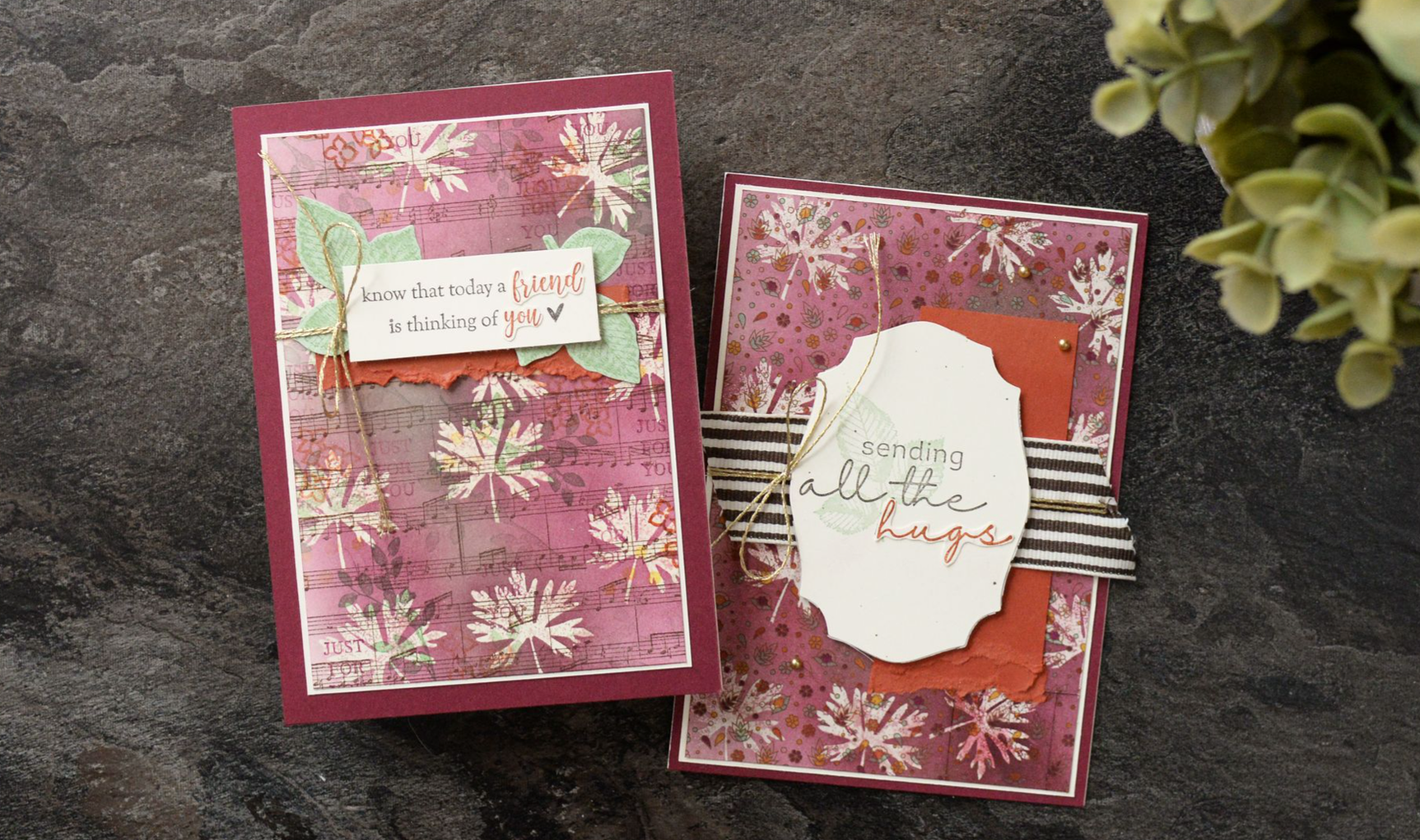
Last week our family was a little under the weather, so creativity felt a bit harder to come by. At times like that, I find it helps to simply play without expectations, and that's exactly how these backgrounds began.
Would you believe that this background started as nothing more than a blank piece of Very Vanilla cardstock?
I really enjoy creating my own patterned paper. For this project, I was inspired by autumn tones, but wanted to give them a fresh twist by letting warm purples take centre stage, with rust and soft mint greens as the accents.
I enjoyed the first background so much that I couldn't resist creating a bonus variation, this time building it over a patterned paper scrap base. This retired Petals and Paisley's paper inspired my colour palette. It's always fun to see how a small change can create a completely different look.
These friendship cards were inspired by several current cardmaking challenges. The Simon Says Stamp Monday Challenge encouraged me to incorporate text into my background, which is one of my favourite ways to add subtle layers of interest. The All About Craft Challenge is celebrating friendship, so I chose sentiments featuring the word "friend," while the Festive Friday National Friendship Day challenge inspired the finishing touches—a knotted gold bow, tone-on-tone stamped leaves, and delicate little floral details added to the background to bring everything together.
I'd love to know—which of the two cards is your favourite?
Craft Along With Me
If you'd like to make these cards along with me, I've filmed a bonus craft-along tutorial that will be shared as my August subscriber freebie.
If you'd like to join my crafty community and receive the tutorial, simply add your email address in the sign-up box in the sidebar. I'll send the August freebie directly to your inbox when it's released.
It's my little way of saying thank you for being part of my crafty community, and I hope it inspires you to create your own custom backgrounds in colours you love.
I'm Jennifer, a cardmaker and papercrafter. I love making beautiful things with intention—using my stash, repurposing materials, and embracing mindful creativity.
Join the Cardmaking Community
Exclusive Cardmaking Tutorials
New creative ideas delivered straight to your inbox.
Join my email community and receive bonus projects, techniques and inspiration — plus access to the subscriber library.
Your bonus is on its way!
If you don’t see it in your inbox, check your promotions or spam folder and move it to your primary inbox so you don’t miss future tutorials.